
Technical Help, FAQ, Product Info. & More
Looking for Technical Help on Engraving, Cutting, Workholding, or Countersinking with our Products?
View our Many Topics Below.
Page Down for Help Topics:
- Find the Right Tool – Filter by Material for Engraving Tools and End Mills.
- Speeds and Feeds (PDF Downloads): Engraving Tools, End Mills, Armor Mills, Thread Mills, Broken Tap Removal Tools, Spring Loaded Engraving Tools.
- Speeds and Feeds Calculator (Downloadable Program).
- Spring Loaded Engraving Tool – FAQ, Speeds & Feeds, and much more.
- Videos: Spring Loaded Tools, Engraving Software Programs, Vacuum Chucks, CNC Dot Peen Marking, CNC Countersink Depth Stop Tool.
- Selection Tips and Information for End Mills and Engraving Tools.
- Smart Part Numbers.
- Custom Tooling – Produced in House.
- Convert Millimeter mm to inches.

Need Help Finding the Right Engraving Tool or End Mill?
Find the Right Engraving Tool!
CLICK HERE to
Sort by Material
Find the Right End Mill!
CLICK HERE to
Sort by Material
Speeds and Feeds
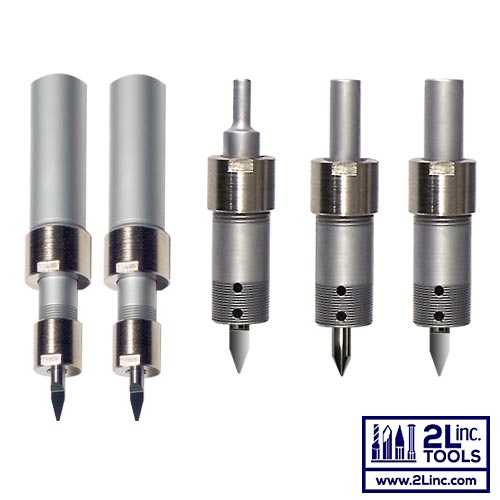
- Speeds and Feeds for Spring Loaded Engraving Tools.
- PDF Format for Easy Download and Printing.

- Speeds and Feeds for Engraving with a Rigid Tool Holder, Collet, End Mill Holder, Etc.
- PDF Format for Easy Download and Printing.

- Speeds and Feeds for Solid Carbide End Mills.
- PDF Format for Easy Download and Printing.

- Machine Granite, Hardened Steels, Armor Plate, and more.
- PDF Format for Easy Download and Printing.

- Speeds and Feeds for machining internal and external threads using Thread Mills.
- PDF Format for Easy Download and Printing.

- Speeds and Feeds for Broken Tap Tools.
- Remove Broken Taps and Drills with Armor Drills and Armor Mills.

- Free downloadable desktop program.
- Simple to use Speeds and Feeds calculator.
Spring Loaded Engraving Tools
- Answers to the common questions regarding the Spring Loaded Engraving Tool.
- Everything you need to know about 2L Spring Loaded Engraving Tools.
- Speeds and Feeds for the Spring Loaded Engraving Tools.
- Printable and downloadable pdf.

- Cycle Time Comparison Table shows how much cycle time can be saved by using a Spring Loaded Engraving Tool.

- Brushes, Polishing Wheels and many attachments can be used can be used with a Spring Loaded Engraving Tool to Polish, Buff, and Deburr workpieces.
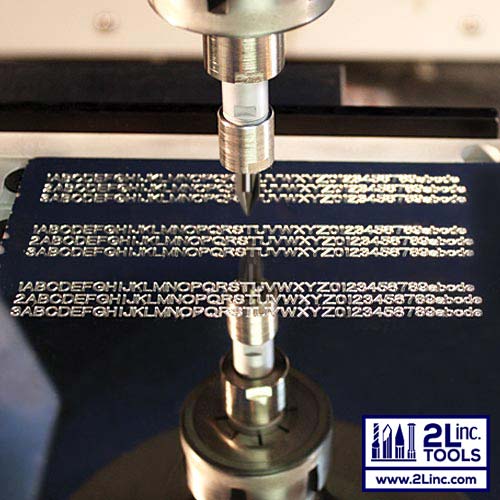
- Engrave Stainless Steel, Inconel, Hastelloy, Steels, Tool Steels, Hard Steels and many other hard materials with a Tough Tip Engraving Tool.

- Use a Diamond Tip Tool, or Carbide Point Engraving Tool Bit with a Spring Loaded Tool for drag engraving, scribing and etching.

- Rotary Engrave, Scribe, Etch and Drag Engrave Glass, Stone, Tile and other hard materials using a Spring Loaded Engraving Tool and Diamond Tip Tool.
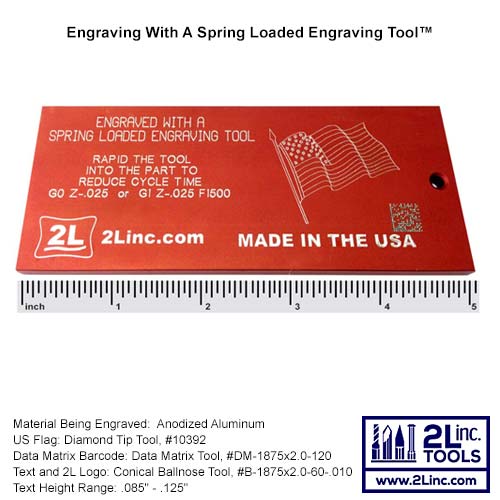
- Use a wide variety of Tool Bits To Engrave Brass, Plastic, Aluminum, and Many Other Materials
Tool Bit Selection and Resources

- Assistance with choosing which style of Engraving Tool to use for a specific application.
- 2L Solid Carbide Engraving Tools are produced in house.
- Quickly Determine the Engraving Line Width based on the depth of cut, included angle and tip width used.
- Easily Adjust the depth, angle, or tip width to determine what tool bit size to use to obtain the width line you need.

- Choose the Right End Mill for the Material being Cut and Machined.
- 2L inc. Solid Carbide End Mills are produced in house.

- Part Number break-down for Engraving Tools, End Mills and Cutting Tools.

- Conversion table for metric tools.
- Convert inches to mm.
- Convert mm to inches.
- Free downloadable desktop program.
- Simple to use Speeds and Feeds calculator.
Videos: Tutorials and Demonstrations

- 2L Spring Loaded Engraving Tools allow you to engrave flat, curved and uneven surfaces, as well as dramatically reduce engraving cycle times when engraving with your CNC Machine.
- This video is a demonstration of the set up and operation of the Standard Size (3/4″ Diameter) Spring Loaded Engraving Tool.
- We produce 5 different diameter Spring Loaded Engraving Tools, in house, to fit virtually any CNC Machine.

- Engraving Cycle Times can be reduced significantly, up to 84%, when engraving using a Spring Loaded Engraving Tool and 2L Single Line Fonts.
- The cycle time monitor in the 2L PRO Engraving Software demonstrates the reduction in engraving cycle times when using a Spring Loaded Engraving Tool compared to a rigid tool.

- The PRO Version of the 2L Engraving Software is a multi-layer engraving software program for CNC Machine Engraving that creates standard G-code nc files.
- Engrave and edit logos and drawings, create detailed engraving layouts, draw shapes, import dxf files, engrave incrementing serial numbers, engrave text on a radius, monitor engraving cycle times, and more.
PRO Engraving Software Tutorial
PRO Engraving Software Tutorial

PRO Engraving Software Tutorial

PRO Engraving Software Tutorial

PRO Engraving Software Tutorial

PRO Engraving Software Tutorial

PRO Engraving Software Tutorial

PRO Engraving Software Tutorial

PRO Engraving Software Tutorial


Introduction to the CNC-CMD Software Program for Error Free G-Code Programming

Detailed Instructions for the CNC-CMD Software Program for Error Free G-Code Programming
How to Adjust the Air Venturi Vacuum Generator Pump

How to Adjust Air Venturi Vacuum Generator Pump
- This video describes how to setup and adjust the 2L inc. Air Powered Venturi Vacuum to obtain the maximum vacuum level.
8″ x 12″ Modular Vacuum Chuck Set Up and Use

- The 2L Modular Vacuum Chucks allow you to use one 8″ x 12″ Vacuum Chuck, or connect 2, 3, 4 or more of the Modular 8″ x 12″ Vacuum Chucks to create the size workspace needed.
- This Modular Vacuum Chuck is easily held in vises already mounted to your cnc machine table. It is a flexible system for quick prototyping and its ease of set up allows for high production runs.
CNC Dot Peen Marking Tool
- Produces permanent dots or pin marks using the rotating spindle of a CNC machine.
- Generates a succession of dots that appear as a line.
- Spring loaded design compensates for variations in the surface height of approximately 0.100″ (2.5 mm).
- Perform high speed marking as fast as the CNC machine can move.
CNC Countersink Depth Stop Tool
- The CNC Countersink Depth Stop Tool maintains precise countersink depth control on materials with tolerance variations.
- Easily control the depth of cut in 0.001″ increments.
- Spring loaded design produces accurate countersinks by accommodating for uneven surfaces.
- Low friction, soft replaceable Plastic Nosepiece reduces potential marring of the surface of the workpiece.
- Hold Countersinks with cutter diameters up to 7/8″.
Machine and Engrave Rough Graphite

- Machine rough and porous Graphite using a 2L inc. Modular Vacuum Chuck and a 3″ face mill.
- Engrave Graphite using a 2L Spring Loaded Engraving Toolholder and Solid Carbide 2L Composite Engraving Tool Bit.